What have YOU seen?

Hey, all of you Stearns Mill Pond denizens and users, what have YOU seen on the pond or brook? Contribute your info - what great sightings, what birds, what animals, what sad things, what changes (good and bad), what wonderful moments have there been? Let's share what we know and love about our pond.
Live on the pond or brook?
Become an author on this blog; send me a message and I will add you to the official author list. Or, if you prefer, just click on the word "Comments" at the bottom of the entry to get a comment box up so you can add your sightings and thoughts. Email me pictures from our pond to post - I will credit them to you.
Click on the picture to see it in a larger format (all photos by D.Muffitt unless otherwise credited)

Monday, October 7, 2013

OTHER THINGS IN THE ROAD

(Edited Oct 9 & Jan 25 below)
Linda & I like to crunch acorns (especially the caps!), so maybe that is why I am looking down these days and seeing lots of things in the road.  Most recently, as of Saturday and the rains, these small seeds, covered in beigeish fuzz, were all over the driveway.  Today, I see lots of them in the road in various places.  I haven't the foggiest what they come from - I don't see any bushes or plants or trees that have fuzzballs on them.
The three on the right hand side were connected and looked like they formed a larger ball - their seeds are still green; on the others, the seed is brown under the fuzz.  Anyone know???
[Jan 25 -- Shortly after I posted this, Carol told me of an article in the Mass. Audubon Sanctuary Magazine (Fall/Winter 2013-2014--available online ). The article, by Michael J. Caduto, titled, "The Oak Tree's World", talks about the oak galls and says that there are more than 800 species of insects & mites that create galls in trees.  The ones we see most on our road/woods are the red balls (common oak apple galls), about the size of the acorns or somewhat bigger.  Apparently, the above fuzzy things are also oak galls.  Mr. Caduto says, 
"While not as common, my favorite galls are the whitish, woolly twig gall and the wool sower gall (white oak), both of which appear like oak-borne cotton balls that are complete with dark spots that look like seeds. These round white tufts are caused by the gall wasps, Andricus furnessae and the Callirhytis seminator, respectively."
In his article,  Mr. Caduto says many interesting things, but two that caught my attention are:
1) Most of the galls are "mearly cosmetic and harmless to the tree" and that some are even beneficial to the tree.  The gall provides food and protection for the growing insect (which is often eaten by a bird!).
2) The tree roots can often distinguish beneficial fungi from damaging fungi and will attack the damaging fungi as soon as they invade the root tissues, but will allow the beneficial fungi to grow!]

A few weeks ago, every night when I'd take Blake out for his pre-bed outing, I'd see daddy-longlegs all over the road!

Last week, Carol and I were walking down Crystal Lake Drive and saw four small (baby?) snakes, run over, on the road.  We don't know what the snake is, either.  They were near Crystal Lake and Willis Lake, so a water snake seems logical?  But I really haven't a clue.  I don't know my snakes...
Anyone know?   [Oct 9 -- I emailed Mass.Wildlife@state.ma.us and got an answer.  They were juvenile Northern Water Snakes (Nerodia sipedon).] 

 (Double click to see the picture larger)

The green webbing is Blake's leash - 3/4" wide.  On the snake's lower jaw, there were white marks - a distinguishing feature of all 3 snakes that we saw.

Even looking down, it is interesting around here!!

Thursday, September 26, 2013

WOOLLY BEAR CATERPILLARS

Recognize this little guy?

Yup, a wooly bear caterpillar.  In the spring, it will turn into an Isabella Tiger Moth.  On my walk with Blake on Monday, I was seeing them all over the road (most were rather flatter than this one - ewww...).  Wednesday, I had to look hard to find this one intact in order to take its picture (I think it was dead, though I didn't check).  

I wondered about the weather prediction myth around the woolly bears so I checked a couple of websites.  (If the brown band is large, over a third of the caterpillar's body, the winter would be mild.)  I thought the Old Farmer's Almanac website,
http://www.almanac.com/content/predicting-winter-weather-woolly-bear-caterpillars 
had the best and most interesting description, of the myth, the origin and the facts, and of course, OFA would be interested in things that forecast the weather!  Check it out.  

OH... and the website said that they are crossing the roads to find over-wintering habitat under bark and in crevices in rocks and logs.


Friday, September 20, 2013

MORNING PADDLE

I paddled upstream in the pond on this beautiful crisp clear morning. It's quite weedy and mucky in the center and the lower end of the pond, but it clears out as you get upstream, closer to where the brook enters the pond. The area right before the mouth of the brook is weedy again with lots of water chestnuts, especially around the edges. This is the area the harvester didn't get to before it broke down.

I saw several wood ducks this morning; They are definitely beginning to congregate before migration. There were also many mallards, of course, and the great blue heron was right at the mouth of the brook.


There was also a busy muskrat going back-and-forth, back-and-forth, across the pond. They can really move fast. I decided not to bother all the critters at the far end of the pond this morning and just watched from a distance (I remembered to bring my binoculars today!).

When I arrived back at our landing, after watching the Kingfisher for a while, there was a raccoon very busily walking along the shore, around the tree and up to the kayak. I couldn't figure out what it was doing, but it was quite intent. The coon sure wasn't very aware; I pulled up pretty close in my canoe, and he didn't even see me until I said, "Good dog" to Blake (he was being quiet). Actually I'm not sure Blake saw the coon either until we got closer. As I spoke, the coon got nervous and hid behind the tree looking like it was about to go up the tree. I scared it off so I could look at the bird's nest --wait!  What is the lump sitting in the tree? I think it's the coon. Yep. It's the coon. I'm in the house dictating this blog entry and happened to look up at the tree and saw a lump that I don't remember. Then it moved. Binoculars handy, and it is definitely the coon staring right at me.

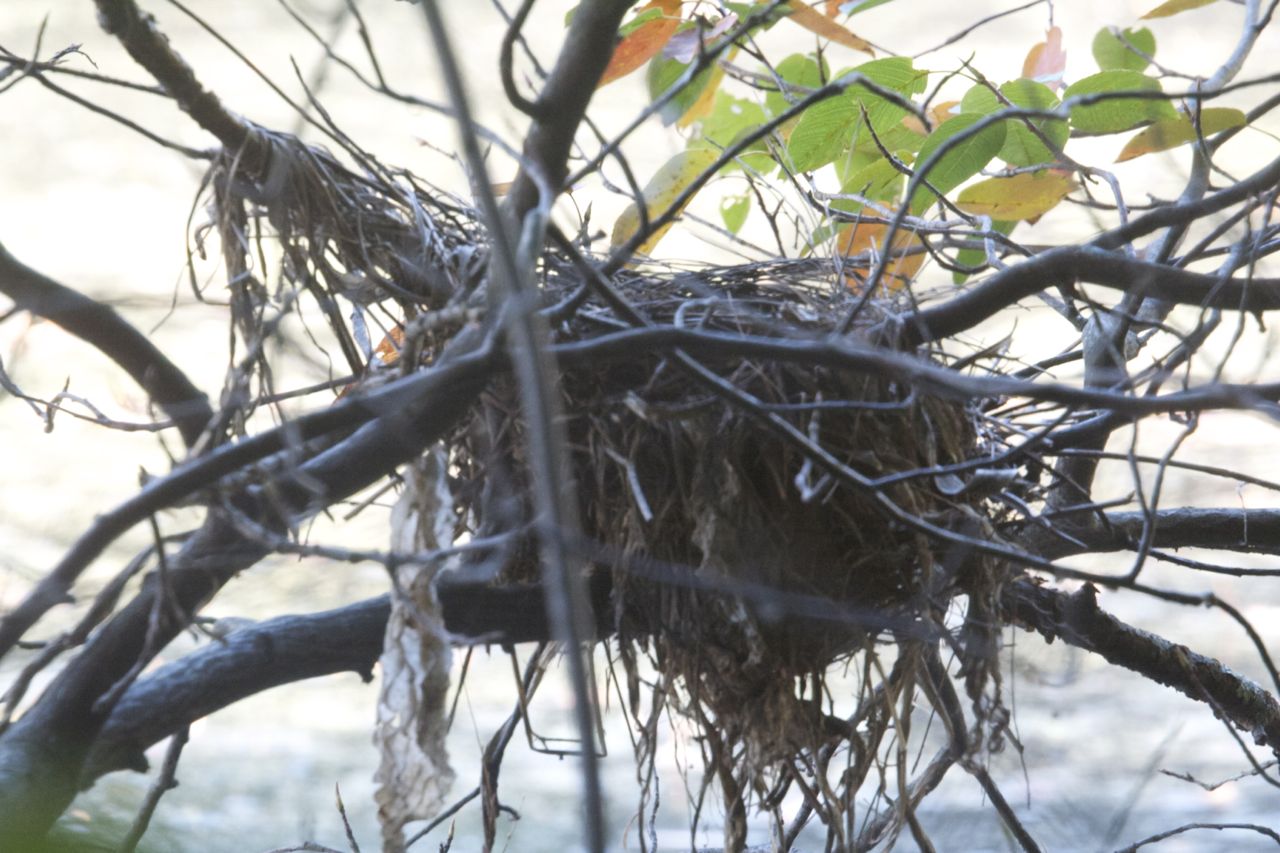
I got a photo of the birds nest that hangs over the pond this morning from the canoe. In this photo, which is closer, you can really see how messy the nest is, and that there are strands of fibrous material tying it to the branches. 

Nest from pond side

Never a dull moment around here; there is always something new to see!


Wednesday, September 18, 2013

DAWN PADDLE

Chilly, misty morning on the pond - 39ยบ according to two of the weather apps (I forget to look at our thermometers...).  I also forgot to take my binoculars, so couldn't see what the ducks were, but I know the wood ducks are starting to gather.  Morning sightings include a great blue heron, a muskrat, a kingfisher and an unknown hawk.  Perhaps a red-shouldered?  It was a buteo, not an accipiter, but looked too small, with too short a tale for a red-tail, but I'm not really good at identifying the red-shouldered.  In any case, it was gorgeous flying through the blue sky!

There is a bird's nest, larger than a robin, but not huge like a hawk, built on some branches of a tree leaning over the water.  

Location of nest on branch over water


closeup

I'm thinking maybe one of the grackles that I frequently saw down by the water, or I suppose a red-winged blackbird or even a blue jay?  I don't know enough about nests. Cool to look at, though!

Tuesday, September 17, 2013

OWLS & OTHER SOUNDS BEFORE DAWN

We've been getting up really early, about an hour before dawn, and sitting on the porch with a cup of tea or coffee. The morning sounds are wonderful. Crickets abound.  Some days it's been too cold for Katydids, but others, we'll heard one, very slowly "KT".  They are temperature sensitive and the calls get slower and slower as it gets colder.  The Katydids die at the frost.  

Apparently, you can tell the temperature by counting the calls per minute (I'm not sure if that means syllables or the whole call & I can't find it anywhere -- ex: if it is cold, you will hear, "Kay....... Ty"  or sometimes just the "Kay" part!)  Anyway, here is the formula presented by the Hilton Pond Center, York, S.Carolina, http://www.hiltonpond.org/thisweek010901.html
(I like the closing comment <grin>)

  • T=(C+161)/3, with T being the Temperature and C the number of calls per minute. This won't work in winter, of course, since all the stridulating katydids will be dead, so unless you're a classroom teacher helping students with math skills, maybe it would just be easier to buy a new thermometer.   
I think we have the Common True Katydids here.  They like oak trees (which makes our neighborhood a good habitat!)

Several days ago we heard two great horned owls calling to each other. The next day we heard two screech owls alternating calls. The day after that, we heard a barred owl across the pond, and a bit later also heard a screech owl from the other side of the pond.

The owls seem to be out and calling just a bit after five which is about an hour before sunrise. Later, the great blue heron squawks. Yesterday, we heard the Heron three times from the dam end of the pond, and once from upstream further. 


Morning is not quiet around here!

Wednesday, August 21, 2013

HARVESTING PROGRESS

Chris Wilson is the operator who has been maneuvering the harvester up and down the pond daily since he and a team of others put it in last week Monday.  As I said in my last post, I was concerned about whether or not the work we had done with the hand pulling the water chestnuts in June would have lasted - it did. 
Pull-a-thon in June
  
I was also concerned about whether or not the nuts would be falling off as the harvester hit the weeds, it being rather late in the summer.  When I checked the nuts last week, they were still tightly attached.  All has been going well!

I went out yesterday to see what the area up stream from us looked like; before the harvester it was totally matted -- below is a picture of what it looked like in early June and by early August, there was no thought of trying to paddle through it!


NOW, post harvester, it looks like this!!
Nice, eh?  


Katrina Scheiner and 5 students have been working in canoes to pull the weeds from the edges where the harvester can't reach (the device needs at least two feet of water).  The town DPW has also worked on the this project, helping with the launching of the harvester, moving the harvested weeds, building up the dam, etc. (Thank you Bill Place and crew!)  The dam has a strip of metal across the top of it and sand bags where the breaks are in the lower part of the dam, consequently, the water is a bit over a foot higher than it usually is.  What great paddling last night!!  With the extra water and no weeds, Linda and I (& Blake) were able to paddle all the way to the mouth of the brook, right down the center, without getting stuck in mud!  If you love to paddle our pond, right now is a terrific time to do it.  

So here is the bad news.  The harvester broke down again (it has broken several times this summer).  Chris is quite adept at repairs, but this time it has to go in to the shop again.  Too bad, cuz I think with the last three scheduled days this week, he could have gotten to some of the edges that are still weed choked.

There is also a long term goal to be able to have the pond dredged, which would help get rid of not only the mud, but also the extra phosphorus and other excessive nutrients deposited in the water from the Marlborough Easterly Waste Water Treatment Plant.  You know all the slime on top of the pond?  It is an algae called, "Hydrodictyon" or "water net" and feeds on phosphorus.  If the phosphorus levels are where they should be, (.1mg/liter) the water net (slime) dies.  More that that and it thrives, as it is now.  Of course, the other problem with too much phosphorus and too many weeds is that the extra plant life uses up the oxygyn in the water, so that the fish die.  If the fish are gone, the herons, king fishers and other fish eating birds go away and essentially, the pond dies.

The other green stuff floating on the pond is duckweed (the plant with little, tiny leaves). As you look at the pond from the dam area off Dutton, it still looks pretty bad; that is duckweed and water net, not the water chestnuts; they have mostly been being harvested.
Duckweed and water net algae

We also have other invasive weeds, particularly evident upstream, near the mouth of the brook.  These too, would be eradicated by dredging.  So, there is hope for the health of our little pond and for the whole Hop Brook system and the Sudbury River (Hop Brook empties into the Sudbury River).

A big thanks to all who have helped and particularly, the Hop Brook Protection Association for its work to cleanup and preserve our pond and the whole Brook. HBPA has done a great deal of fundraising and grant writing to get enough money to take care of the problems, a small example being, HBPA paid the $1850 to move the harvester from Carding Mill Pond over to Stearns Mill Pond. (If you aren't a member, consider going to the website and joining/making a donation.  It matters.)

Tuesday, August 13, 2013

POND HARVESTER

The harvester is here and working near the dam end of the pond to clear away the water chestnuts.  The water level in the pond is quite low (normal for August), so I hope that they are able to build the addition on the top of the dam to raise the water level a bit.  

There is also a group of several college students, interns, who are working in canoes and pulling weeds from the sides where the harvester can't maneuver.  I was concerned that the pulling we did in the spring would be negated by the spreading chestnuts, but the  sides of the pond are still mostly clear where we worked in June, so that is good!  We can look forward to an improved pond soon!

There was a flock of Cedar Waxwings eating the bugs off of the water chestnut mats last evening.  Quite a few of them were there - more than usual, I think.